"Please Don't Pray For Me"
I felt myself slip into explanation mode.
The other day, I was talking to someone who asked me “how are you doing?” I knew the question was coming from concern, not nosey-ness. And there’s no telling what they had heard—or what they thought might be going on with me. Not sure why I felt like I needed to defend myself.
I updated them on my life and tried to give them as little detail as possible. At the end of the conversation, they confidently said, “Well, now I know how to pray for you.”
It was sincere and came from a loving heart. So why did my chest tighten at those words?
And why did I immediately want to respond, “please don’t pray for me”? Of course, I didn’t say anything—I just smiled as I took inventory of my inner atmosphere.
My body and emotions did not like the conversation, but my mind acted according to its programming—analyze and diagnose:
“Is this triggering because you are bitter at Christians? You’re angry at God? Why are you judging? The problem is yours, and you need to deal with it.”
It has taken me years to learn how to sit with the chattering-of-the-mind without responding. And it still is a daily practice. Because once you heed the mind’s diagnosis, the antidotes become an endless web🕸️. The mind has been programmed by a system and like any system, it needs consistent engagement to survive.
Don’t get me wrong, I am all about healing and dealing with my shadows, but the programmed mind is not an authority that I trust.
So, I don’t fight or condemn the mind—I just wait. And in the silence, the voice of truth will emerge from within. I simply create space and wait for her voice.
“Her” being the eternal mind of me.
The Ancient Aramaic word for prayer is slutha—to set the mind like a trap. A trap does not chase after what it hopes to catch. It is simply set—open, still, and waiting to capture what is true.
Today, we would say prayer (slutha) is like a tuner.
It does not create the signal. It listens for the one that is already there.
There is a patience to it—the gentle nudge of the dial, moving slowly through the static without forcing the message to appear. Then, without fail the static eventually gives way to the voice that has always been underneath.
And there it is.
The true signal.
You recognize it immediately—not because it shouts above the static, but because something within you already remembers its voice.
Prayer does not create the signal. It quiets the noise long enough to receive what has been there all along.
And here lies the irony:
The origin of Prayer is not speaking, asking, begging, talking to God. But to become still, rest the mind, and wait patiently for the inner voice to emerge through the static.
While “I know how to pray for you” suggests the waiting and listening is already over.
The condition has been diagnosed.
The outcome has been prescribed.
Now prayer already has a destination.
And in my experience of Christianity, the assessment of your condition always came down to Lordship. Who—or what—was governing your life?
But the diagnosis was already skewed because it was framed by my belief. I wasn’t setting my mind to receive from a place of openness. I had already decided what the answer was.
I wasn’t gently turning the dial, listening for the true signal beneath the static.
I was tuning it to the station that I had already chosen.
And I trust me, I can speak with authority on this one—for twenty years, my radio allowed only Christian music through. While you were rocking to the devil 👿 playlist, I was listening to Carmen and praying for your soul.🤗
And it is not my place to tune the dial for you anyway.
The audacity.
I chose the station. My beliefs provided the soundtrack. My programming wrote the lyrics. Then I told you what my God had to say to you.
Sure, I can become still enough to hear what is true within me, and I can hold space for you while you do the same. But the moment I decide what your signal should say, I am no longer listening. I am running the program.
When I woke the next morning, I saw the whole exchange clearly. I realized I wasn’t rejecting her desire to pray for me. I was rejecting the implication that they knew how to pray for me. I know this framework all too well—I lived from it for most of my adult life.
The Christianity I was a part of was the Spirit-filled, increasing in radical love, way-of-living❤️. On this path, I allowed what wasn’t eternal love to be burned-up layer by layer.
🔥🔥🔥🔥🔥🔥🔥
Love in Ancient Aramaic is the word Hube’ meaning to set a spark and gently breathe on it. The way you tend and protect a fire is the way you tend and protect love. And when the spark receives enough care—it will become a consuming flame, burning-up everything that it is not.
🔥🔥🔥🔥🔥🔥🔥
The thing about allowing love to breathe—is that it keeps expanding until every bit of the conditional framework is consumed by its flames. This is simply the nature of eternal love.
My life’s goal was to fan the flame—and well… as fires go, it did get out-of-hand and it did engulf every structure that attempted to contained it—that attempted to contained me.
Shhh… I am that flame.🔥
Of course in the church, I was encouraged to fan the flame—as long as it burned inside the system and served the “go into all the world” agenda.
My prayers were constant: that others would meet Jesus, experience God’s love and—wait for it—accept him as their Lord and Savior in order to live eternally in his loving, heavenly bliss.
“You cannot have unconditional love with a judgment” —Darius J. Wright
Bottom line—a diagnosis names a condition. The moment I diagnose what you lack—“you need to know my God”—I have placed a condition inside what I have named unconditional.
As long as I was convinced the world needed to know my God, my love had a destination. And my prayers were framed by my agenda. (my oh my)
🙏 Listen, for years— I hosted the all-night prayer meetings. The on-location prayer services. The forgiving. The declaring. The governing prayers for the nations.
I taught my daughters how to “govern through prayer.” And I have witnessed firsthand what prayer can do. I don’t have a problem with prayer…but I have seldom seen it happen outside an agenda.
We analyzed the lack, the suffering, the hurting, the lost—and then we diagnosed:
They need to know our God.
At bedtime with my children, we cried over the suffering in the world. We interceded for countries. We learned their names. We read about the poverty, the famine, the persecution, and the people who had never heard the Gospel.
Remember the 10/40 Window? Not on our watch! We would stand in the gap and call in the ones who have never met our God.
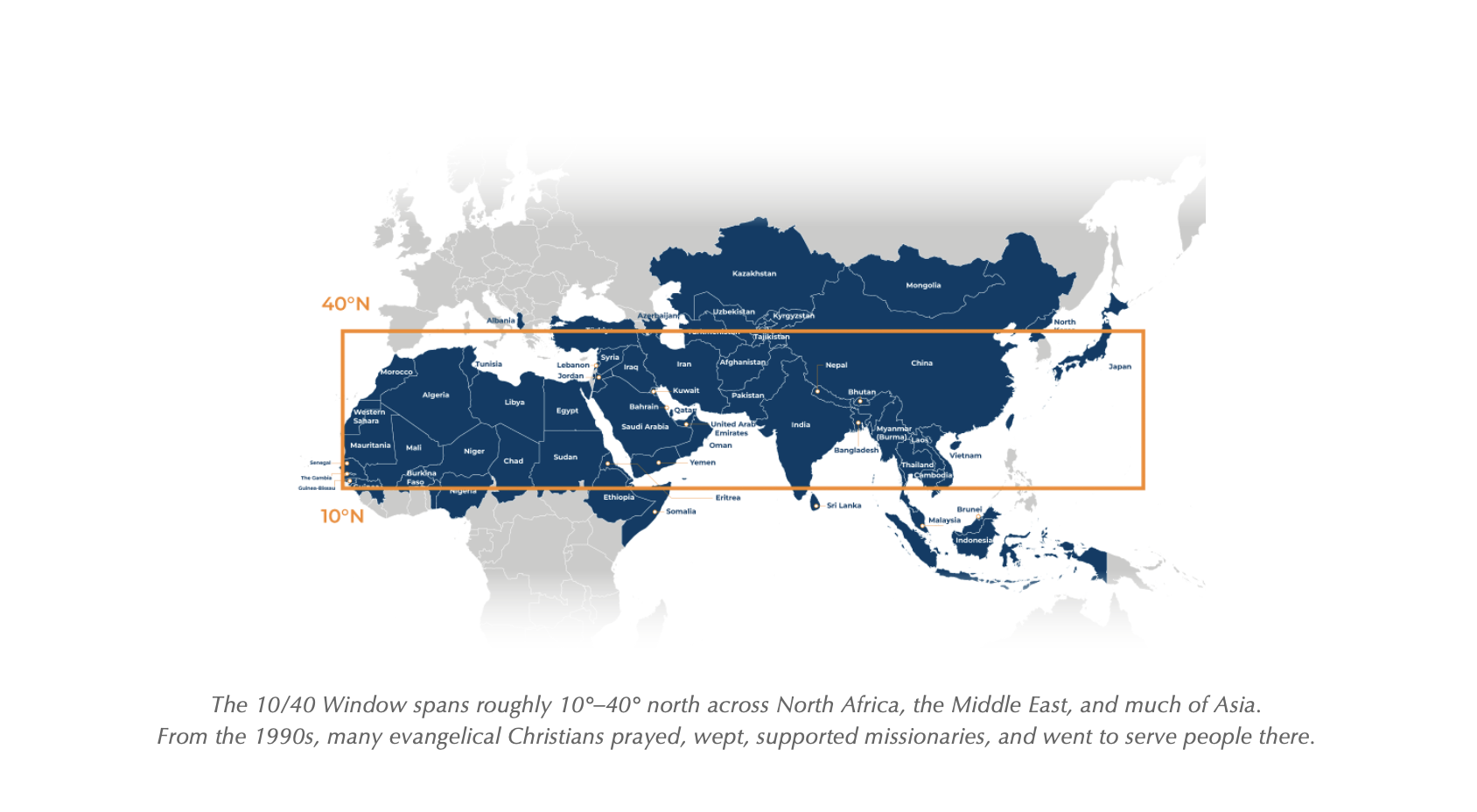
Our hearts were beautiful. Our goal was love—God’s love—our God’s love. The God we served, they should serve, and problem solved!
Our hearts were pure—but our diagnosis was framed by an agenda.
Like a doctor who studies medicine with the intention to help people —but is trained by a system Christians seem to follow the same protocol:
1) diagnosing the condition
2) prescribing the medicine
3) getting the kickback
We would diagnose the world as lost.
The prescription was belief in our God.
And the spiritual kickback was God’s approval, the lifting of guilt, and the feeling that we were loved because we had answered the great commission—“Go into all the world.”
Take as directed.
Side effects may include:
Guilt. False responsibility. Chronic urgency. Fear of disappointing God. Difficulty resting while anyone, anywhere, is suffering. Compulsive intercession. Spiritual hypervigilance. An inflated sense of responsibility for other people’s eternal destinations. Mistaking anxiety for conviction. Mistaking exhaustion for obedience. Mistaking control for love. And the persistent belief that everyone else’s soul is somehow yours to save.
If symptoms continue, pray harder.
Those side effects were not theoretical either. I watched them take shape in my own home.
I remember my ten-year-old daughter sobbing as we prayed for the missionaries in China. I wore her tears like a gold star for Christian parenting. I felt proud—and responsible—for how deeply her little heart ached for the nations.
Thirty years later, her therapist has confirmed my responsibility in the aching of her heart.
I discipled her well, and plugged her right into the system🥹.
“Well done, thou good and faithful servant.”
Too bad we can’t cash that gold star in to on pay her therapist.⭐️💰
Don’t get me wrong—I am glad that I taught all my daughters to love humanity. They are incredibly compassionate adults today.
But compassion and responsibility are not the same.
I had braided compassion and guilt so tightly together that I could no longer tell where love ended and obligation began.
To live in peace felt irresponsible, uncaring, and lazy. If we loved God, we had to love “the least of these.” As long as there was suffering, how could we sit on the only answer we knew for the world—Jesus?
After all, “the burden of the Lord” is a heavy load.
My chest tightened because my body recognized something my mind had not yet named. A diagnosis. A destination. A loving “concern” that had already decided exactly what I needed.
I am not here to say anyone is wrong for praying for me.
But I will not betray myself by accepting the prescription hidden inside their prayers.
I can honor their love without becoming loyal to their agenda.
Unconditional love is not something to achieve.
It is the eternal nature of who we are.
Any and all “conditions”, no matter who said them are layered on top of truth.
Every judgment. Every diagnosis. Every requirement to become something else.
Love will never lead you away from yourself.
It will simply burn away what never was you in the first place.